
Broken Arrow City Directory Collections
Broken Arrow has no single, continuous run of printed local volumes identified in the research. The most useful shelf starts with the Tulsa City-County Library Genealogy Center resources, which document Tulsa runs for 1928 through 1932, 1939 through 1941, and 1948. Those volumes can help with regional research, but Broken Arrow coverage may be indirect or absent. The library also points researchers to its documented Broken Arrow Genealogical Society and Museum Broken Arrow library leads, Ledger microfilm, a White Church Cemetery registry, genealogy CDs, Hall of Fame material, and a published 1910 federal census for Broken Arrow, Tulsa, and adjoining townships. Confirm holdings and hours before a visit.
| Collection | Years | Where Held | Access |
|---|---|---|---|
| Tulsa city-directory run | 1928-1932, 1939-1941, 1948 | Tulsa City-County Library Research Center | Research collection; Broken Arrow coverage may be indirect |
| Broken Arrow Genealogical Society leads | Dates vary | Museum Broken Arrow library | Verify holdings and hours onsite |
| Oklahoma Historical Society directories and phone books | Dates vary | Oklahoma Historical Society Research Center | Non-circulating; vault relocation can affect access |
| Broken Arrow Ledger | 1904-1906 early run; later holdings 1925-1979 | Gateway to Oklahoma History and library microfilm | Online coverage is limited and not continuous |
The table is a coverage map, not a claim that every year or every household is present. A missing name can reflect a gap, a regional publishing choice, an alternate spelling, or a person who was not listed. Record the collection, year, page, and whether the item is an index, a scan, or a physical volume.
Tulsa Library genealogy resources identify the local historical leads used for this Broken Arrow city directory work.
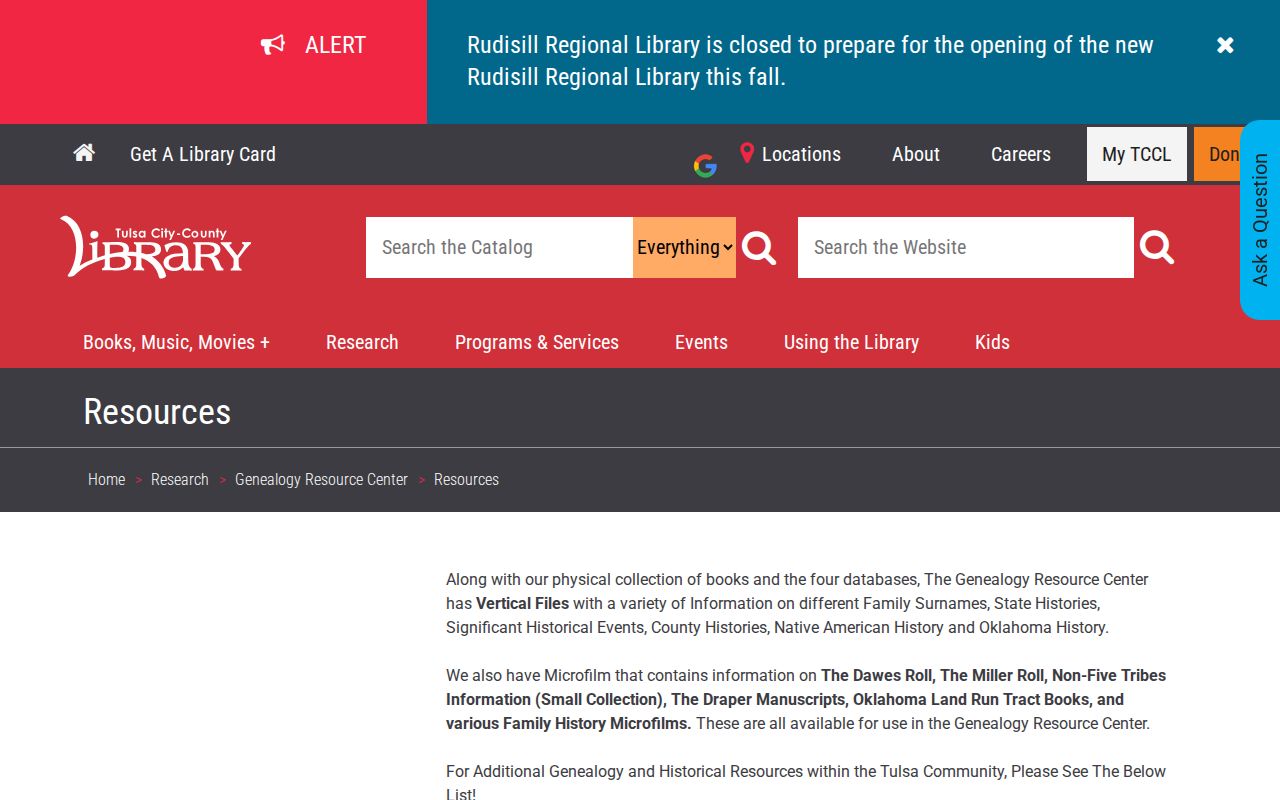
The resource list is a starting point for collection discovery, while the item itself supplies the date and entry-level evidence.
Broken Arrow Directory Research Shelves
The Oklahoma Historical Society Research Center broadens the search beyond a city directory. Its holdings include more than 90,000 bound volumes, along with family histories, yearbooks, directories, phone books, census indexes, newspapers, and local-history material. City directories can arrange people by name, address, or occupation, and often separate businesses and agencies by category. These sources are non-circulating. The research notes also warn that vault relocation can limit what is immediately available, so an onsite request should name the place, a probable year, the person, and alternate street forms.
A finding aid lists a Broken Arrow booklet dated 1903-1904 within the John W. Kirschner collection and Tulsa County material dated 1903-1928. Its exact title and type remain unresolved. Treat it as a catalog lead rather than calling it a directory. A useful request asks for the title, creator, pagination, geographic scope, and whether it lists households, organizations, or businesses. That distinction matters before the item becomes evidence in a family line.
Oklahoma Historical Society research holdings show the broader archive that can fill gaps around a Broken Arrow city directory.
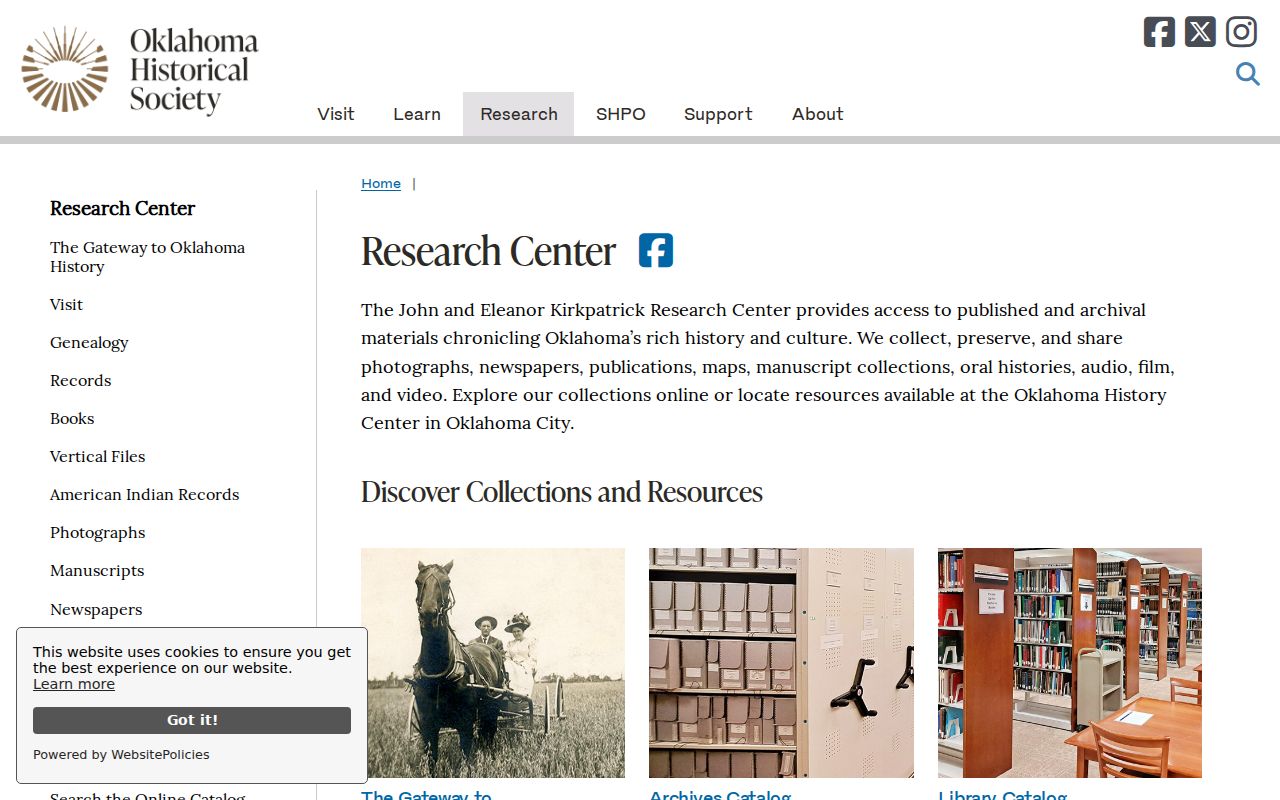
Bound volumes, census indexes, and newspapers often corroborate a dated listing without turning one historical appearance into a current address claim.
Note: Confirm shelf status, hours, and any vault-retrieval limits before relying on an onsite visit for a particular volume.
Broken Arrow Directory Entry Clues
Read a directory entry as a compact historical record. The digitized 1920 Polk-Hoffhine Tulsa sample is especially useful for decoding the conventions likely encountered in regional material. It shows a surname and given name, a spouse in parentheses, an occupation and employer, and address abbreviations. In that volume, r marks a residence, rms marks rooms, and b marks boarding. It is a Tulsa example rather than a Broken Arrow entry, so it teaches the format but does not establish a Broken Arrow household.
| Name string | Copy the surname, initials, suffixes, and spelling exactly as printed. |
|---|---|
| Spouse notation | A parenthetical name can identify a household connection, but it still needs a date and source check. |
| Occupation and employer | Use these as period clues that may distinguish people with the same name. |
| Street address | Retain the original wording before matching an old form to a modern street. |
| Residence markers | Record r, rms, or b exactly and consult the volume's key. |
- Criss-cross directory
- A later directory section arranged by street and number instead of by surname. It can place a dated address in its immediate historical context.
- Householder index
- An index that points to the person or household entry. It is an aid, not a replacement for the full printed line.
- Abbreviation key
- The page that explains the volume's short forms. Photograph or transcribe it before interpreting a residence, room, or board marker.
The digitized 1920 directory page provides the regional sample used to decode these entry conventions.
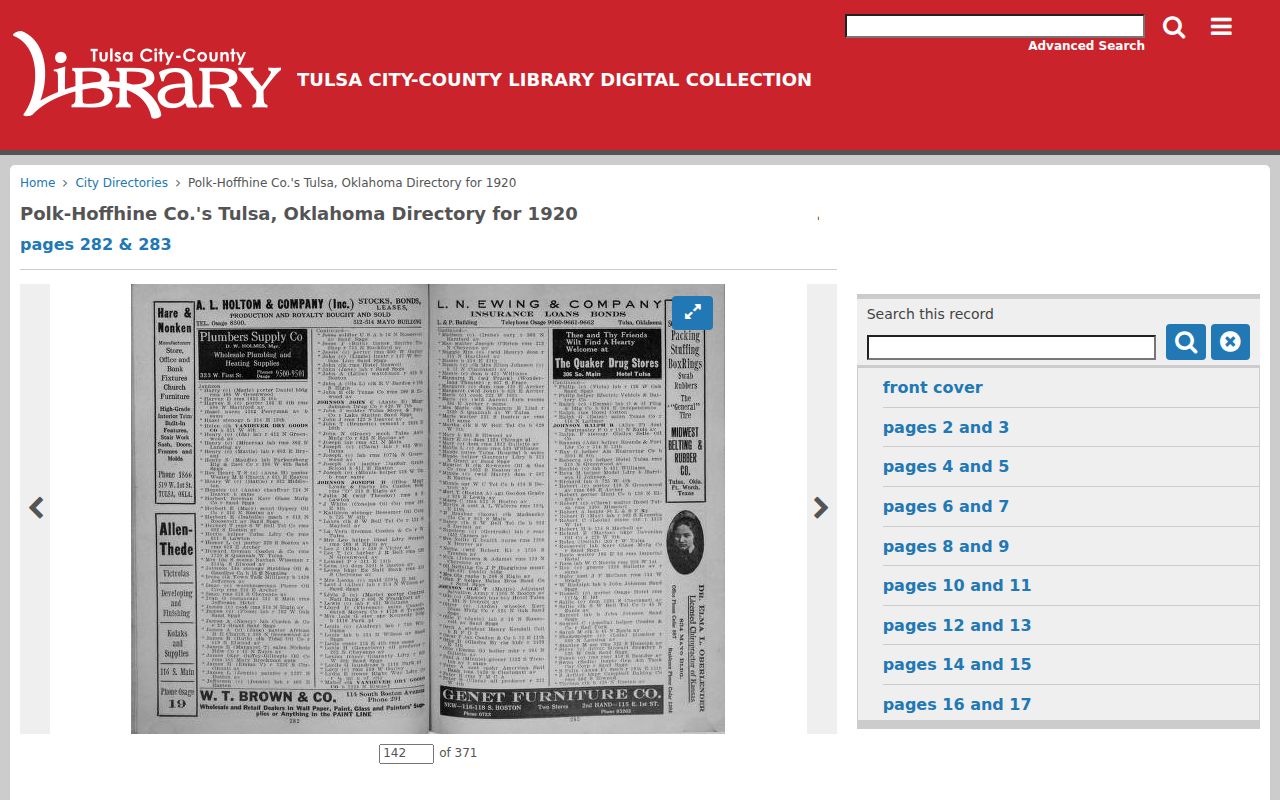
A careful transcription preserves the original line first, then keeps any modernized street form in a separate research note.
Broken Arrow Directory Ledger Capsule
The Broken Arrow Ledger collection at Gateway gives the directory search a dated local companion. The early run contains 106 issues and 867 pages, with online examples from 1904 through 1906. Later holdings span 1925 through 1979, but the digitized portion has only a limited 1960 run. It is not a continuous archive. Search a surname with “Broken Arrow,” old and current street forms, spouse names, organization names, and legal-description fragments where useful. Preserve the issue date and page with every find.
Newspaper items have different weights. A legal notice may identify a public role or a date; a social column and an advertisement have different scopes; an obituary remains editorial and historical rather than a certified vital record. Pair a Ledger result with an archive item, a map, or a county instrument when the question needs stronger confirmation. The local paper is most valuable for narrowing a date or spelling, not for making a claim about current residence.
Gateway's Broken Arrow Ledger title page identifies the limited online newspaper run.
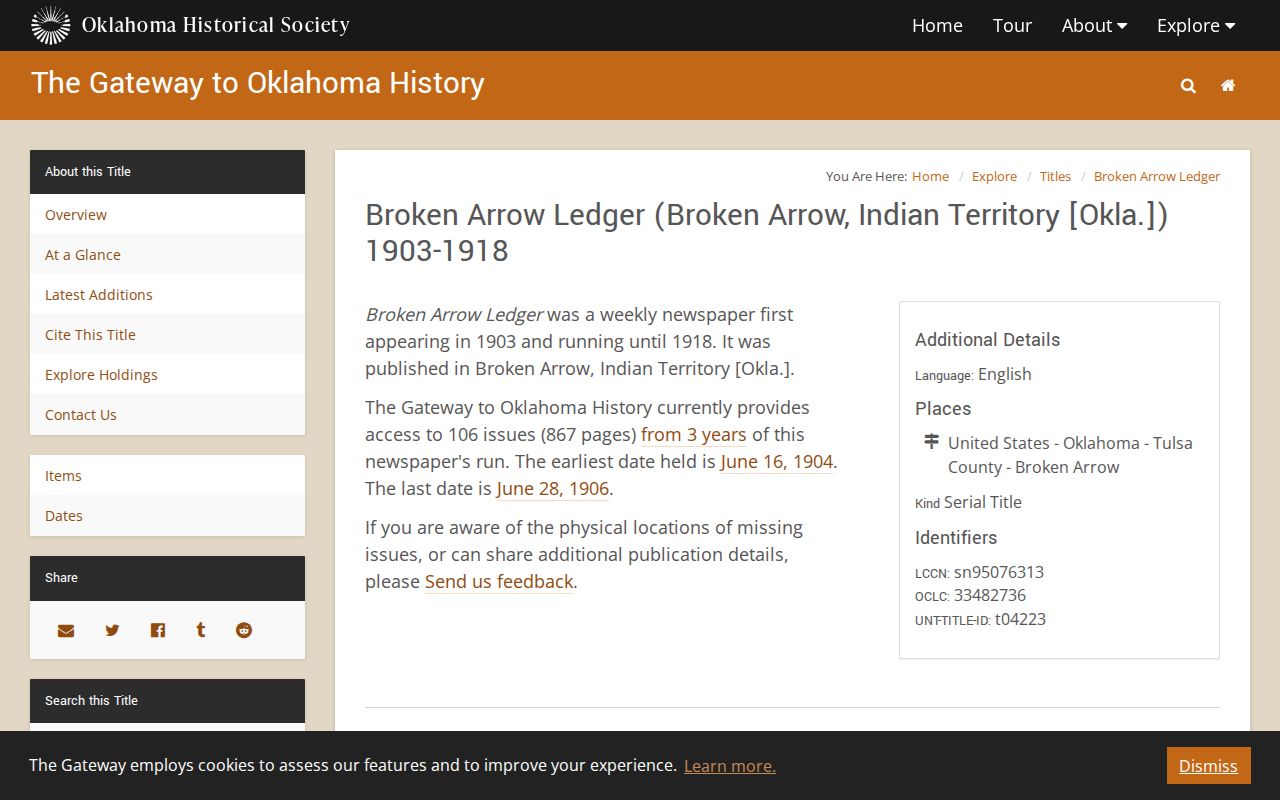
The date and page number make a Ledger citation reusable when later sources confirm or revise the initial lead.
Broken Arrow Directory Timeline
Broken Arrow's early records need a timeline because the original townsite, later street names, and archive coverage do not line up neatly. The city incorporated in 1902. The Katy Depot was built in 1903, moved in 1908, and moved again in 1988. Those moves make it a useful local reminder that a historic address reference needs a date before it is mapped to a modern location.
- 1902: Broken Arrow incorporated, creating the municipal setting for later town records.
- 1903: Katy Depot built; the same period includes the unresolved 1903-1904 OHS booklet lead.
- 1904-1906: Early Broken Arrow Ledger issues provide a local printed snapshot.
- 1905: A two-sheet Sanborn map documents the original built environment.
- 1928-1948: The documented Tulsa directory runs supply regional reference points in selected years.
The timeline does not imply uninterrupted coverage. It highlights where a search may change source types. OHS also notes that the earliest land records in state counties generally begin around November 1907, while federal homesteader tract books are on microfilm by township and range. A gap is normal and should stay visible in the notes.
Note: A dated local landmark or map can orient a search, but it does not establish a continuous record of a household.
Broken Arrow Household Directory Trails
Trace a household one dated source at a time. Start with the first reliable appearance, then keep the exact spelling, source year, original address, and record role. Follow the person forward only when the name, address, spouse notation, or other source detail supports the connection. The published 1910 federal census noted by the library can bridge a directory gap, while later census years can test whether a family remained in the same place or simply shared a common surname.
- Find the earliest dated entry or index lead and transcribe its name and address exactly.
- Check the next available volume or newspaper period for the same spelling, initials, spouse notation, and street form.
- Use a criss-cross section, where available, to place the dated address among nearby historical entries.
- Pair the directory year with the closest census, preserving the census place and date as separate evidence.
- Use the Ledger, cemetery registry, or an authorized vital-record route to explain a disappearance only when the source supports it.
A name leaving a volume can mean a move, a death, an omitted listing, a spelling change, or a coverage gap. Do not choose among those explanations without another source. When a historical address needs a current parcel or county route, use the modern address material on the Broken Arrow Street Directory rather than treating the older listing as a current property record.
Broken Arrow Directory Home History
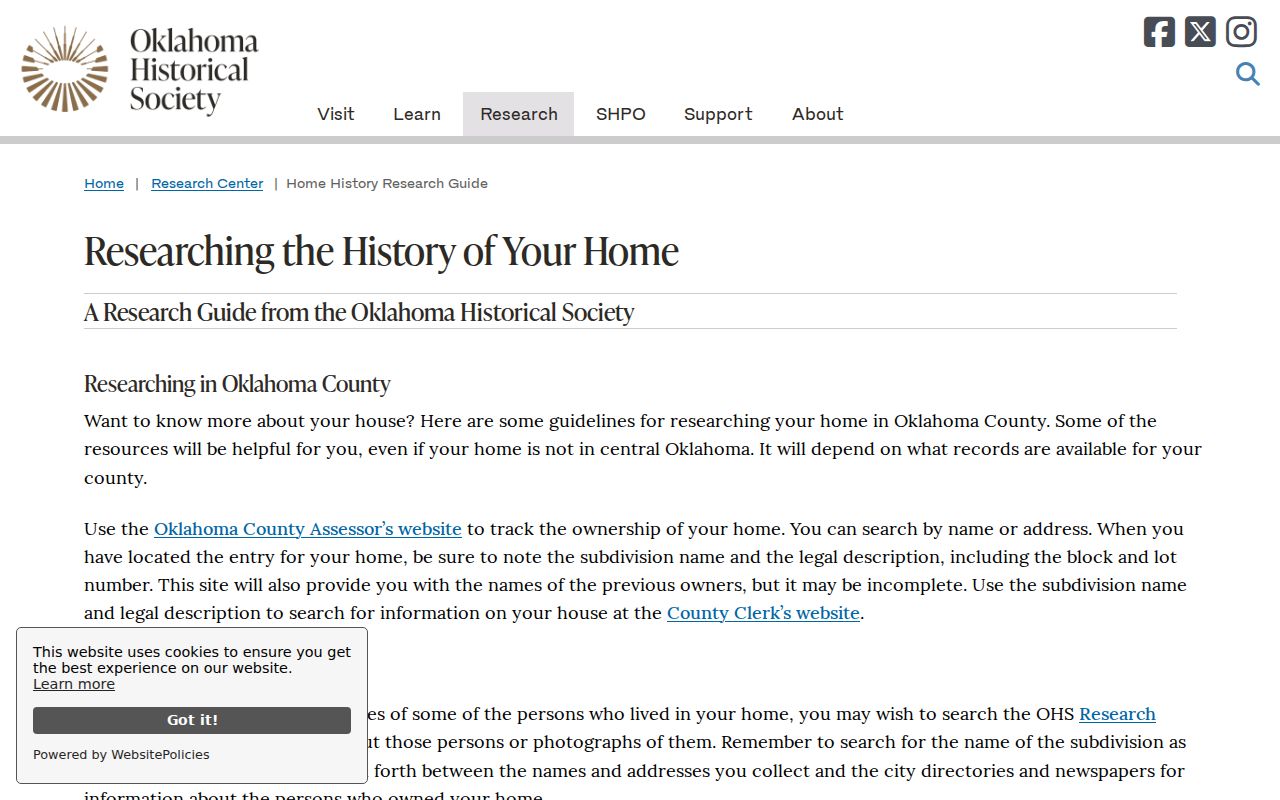
The Oklahoma Historical Society home-history guide offers a disciplined way to connect a historical listing to a place. Begin with an assessor search by name or address, write down the subdivision, legal description, block, and lot, then use the County Clerk for prior recorded owners. Continue with directories, Sanborn maps, newspapers, and address or name combinations. The guide cautions that previous-owner lists can be incomplete and recommends spelling out numbered streets and directions.
For Broken Arrow, normalize the street first. E Avenue became Broadway, and 2nd Street became Main. Retain the original wording in a citation, then record the modern search form separately. The 1905 Sanborn is a two-sheet snapshot of building footprints, construction materials, uses, and named streets at that time. Later aerial holdings at the library can add visual checkpoints from the 1950s, 1960s, and 1970s, but none is title evidence.
The OHS home-history guide sets out the address-to-record sequence for historical research.
Keeping old and normalized street forms side by side prevents a later parcel search from silently changing the historical source.
Broken Arrow Directory Record Gaps
Several limits are part of an accurate Broken Arrow city directory search. No official 1910 or 1920 Broken Arrow Sanborn map was located. No official public Park Grove Cemetery grave or interment lookup was found, although the city provides cemetery service and deed contacts. The Research Center's aerial holdings are useful context, but exact frame availability needs onsite confirmation. These gaps do not mean the person or place was absent. They mean a different custodian, a physical collection, or an authorized request may be needed.
Park Grove is city-owned on Houston/81st between Elm Place and Aspen. The research identifies 918-259-2411 for deeds and 539-357-1658 for cemetery operations. A cemetery deed holder is not necessarily the person interred, a visitor, or a current resident. Keep the question narrow and preserve the source date. For a death certificate or record index, use the state route rather than treating a newspaper or cemetery lead as a certified result.
Broken Arrow Directory Source Roles
Label every result by what it actually records. A historical directory entry, a newspaper mention, a cemetery contact, a recorded owner, and a tax-roll name answer different questions. The strongest family-history note keeps the source authority, record date, access date, original address string, and any normalized modern form. Broken Arrow spans Tulsa and Wagoner counties, so a later parcel or recorded-land check must be routed by boundary and parcel, not by mailing ZIP.
Use an original-source trail: directory line or newspaper page, map or street crosswalk, county route, and any official record requested from its custodian. That approach preserves useful historical detail while respecting protected information and the limits of a dated city directory. Research access conditions and dynamic office information were checked on August 30, 2026.
Note: Historical directory facts should stay attached to their printed year and source role instead of being converted into present-day personal details.