
Broken Arrow Resident Lookup Coverage
There is no single official roster of Broken Arrow residents. A sound resident lookup uses the record that answers the narrow question, then preserves its source and date. Broken Arrow crosses Tulsa and Wagoner counties. County matters for district-court and other county records, while municipal cases stay with the City of Broken Arrow. A voter portal result shows registration context, not a full biography. A vital index can show that a record is on file, but it is not the underlying certificate.
| Record | What It Confirms | Where | Access |
|---|---|---|---|
| Municipal court case | City-code, traffic, or misdemeanor case route | Broken Arrow Municipal Court Clerk | Direct clerk route; no public party-name search located |
| District-court docket | Named party, court, case, events, and disposition details when public | OSCN and the applicable county court clerk | Public portal subject to access and record limits |
| Birth or death index | That an Oklahoma event record is indexed | OK2Explore | Free index; certificate access has separate rules |
| Voter registration | Registration status, districts, ballot, and polling-place context | Oklahoma Voter Portal | Individual lookup with required identity fields |
| State criminal-history request | State repository request route under its own rules | OSBI CHIRP instructions | Controlled request, not a local resident directory |
Use the least invasive record first. A city-code citation belongs with the municipal clerk; a district case belongs with the case's county and court header; a birth or death question belongs with the state index and application route. Do not convert any one of these appearances into a blanket claim about where a person lives now.
Broken Arrow Resident Court Routes
Broken Arrow Municipal Court is at the Justice Center, 2304 S First Place, and the clerk phone is 918-451-8558. Its listed work includes traffic and misdemeanor violations of city ordinances and city-code violations. The city lists traffic and Class A arraignment, non-jury, jury, juvenile, and review docket types. Its public page provides payment and clerk contact information, not a public search by a party's name. A direct request to the clerk is the documented route, and juvenile material is especially restricted.
Felonies and non-city misdemeanors do not belong in that municipal route. Search the statewide system and confirm the county in the case header. For Tulsa County matters, the Tulsa County Court Clerk public-records page identifies court, criminal, marriage, divorce, and property or probate services at 500 S Denver, Room 200. Eastern Broken Arrow matters may instead require the Wagoner District Court OSCN route and its clerk. A Broken Arrow mailing address does not select the county by itself.
Note: Court source, case number, filing date, party role, and status date should remain separate fields in every verification note.
Broken Arrow Resident Lookup Fields
The OSCN statewide docket search offers county and court controls, case number, party last, first, and middle names, born-on-or-after and born-before ranges, lower-court party type, appellate and district case-type controls, filed and closed date ranges, and a traffic citation number field. Enter the narrowest reliable terms. A date range and county can help separate people with similar names, but each case should still be opened and read before it is tied to a person.
Automated research encountered Turnstile on OSCN. That is an access condition, not evidence that a local case is absent. Use the portal interactively, record the access date, and route municipal matters to the city clerk when appropriate. Case pages warn that ancillary issues before January 1, 2000 may not display even when docket entries exist. Online absence is never proof that no case exists.
OSCN's court-search form displays the statewide fields used to narrow a Broken Arrow resident lookup.
The form supports a documented search path, while a result requires a separate identity and jurisdiction review.
Broken Arrow Resident Result Details
A public OSCN case page can show more than a party name. The reviewed interface structure includes parties, attorneys, events, issues, disposition, and docket rows. A docket is the court's dated list of filings and actions. It may contain a date, code, description, count, party, amount, and other case-specific fields. Read those fields as court activity, not as a statement about personal character or current location.
| Case header | County, court, case number, and case type establish the correct jurisdiction. |
|---|---|
| Parties and attorneys | Names and roles that must be compared with the exact case, not a name-only result. |
| Events and issues | Dated actions and topics recorded in the court process. |
| Disposition | The case outcome or status detail when displayed; preserve its date. |
| Docket rows | The chronological case log, which can have gaps or display restrictions. |
Use a case number before combining results from OSCN, municipal court, or a county clerk. A citation, civil filing, protective order, sealed matter, dismissal, and arrest record are not interchangeable. The source role must remain visible so an authorized reader can verify the event with the proper custodian.
Broken Arrow Resident Vital Checks
OK2Explore is Oklahoma's free birth and death index. Its search controls include event type, event date, county, name, and sex. Birth index entries appear after 20 years, while death index entries appear after 5 years. The result indicates that a record is on file. It does not display, certify, or replace the certificate, and it does not establish that the person was a Broken Arrow resident at any later date.
The Oklahoma State Department of Health Vital Records route controls the certificate transaction. Birth certificates are open at 125 years and older; death certificates are open at 50 years and older. Younger records have statutory relationship or authorization and identity requirements. The standard search or copy fee is $15, with additional copies also $15. Online or phone orders can add a convenience fee, while mail avoids that convenience fee. The form and current fee notice should govern an actual order.
The Oklahoma birth and death index is the official search surface for the event fields described here.
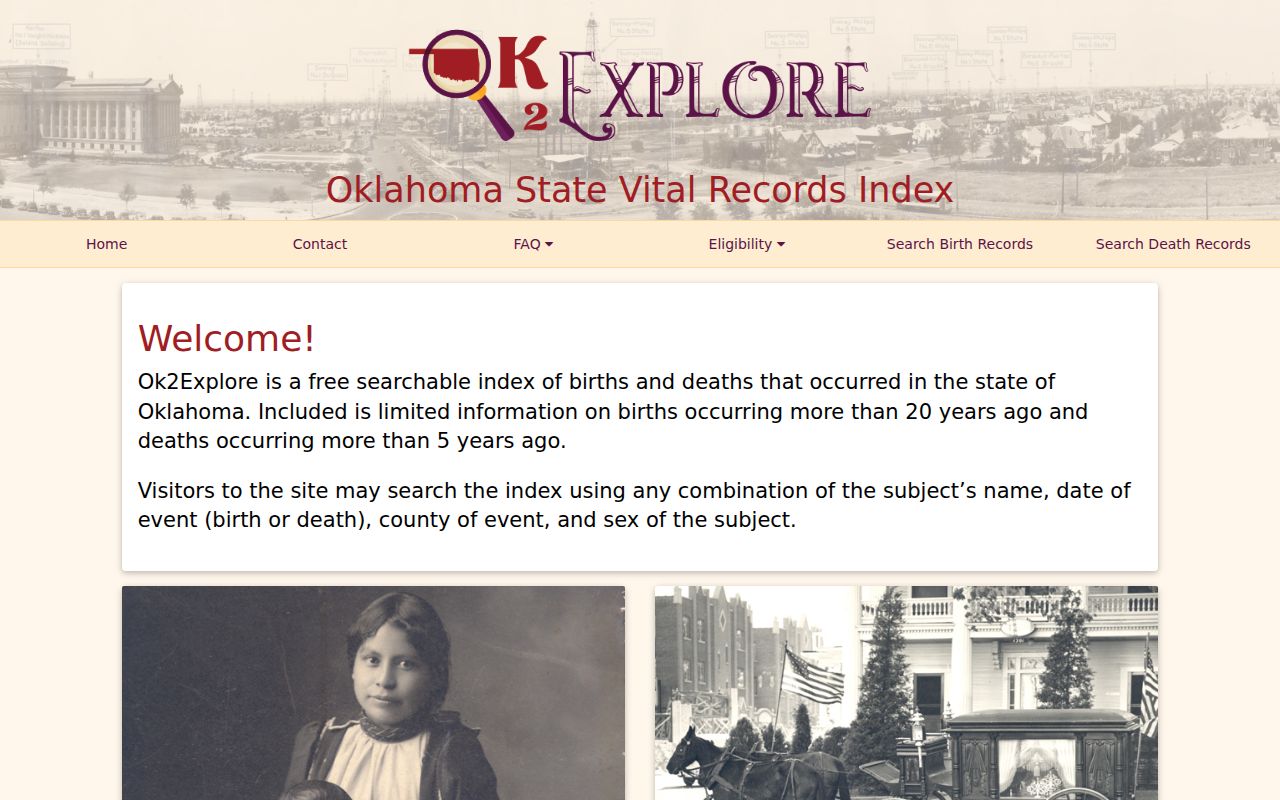
An index hit is a research lead; an official certificate is a separate custodian record with application, identification, and fee rules.
Note: Statewide vital filing began in October 1908, was not mandatory until 1917, and has incomplete pre-1940 coverage.
Broken Arrow Resident Index Timing
Dates control how much a result can say. Oklahoma's birth index becomes searchable after 20 years and its death index after 5 years, while the certificate access ages are much longer. Voter history may take four to five weeks to appear after a statewide election. Court docket status, portal links, office hours, and fees can also change. A result should therefore show both the record date, if displayed, and the date the official source was checked.
These timing differences are useful checks against overreading a screen. A new vital event may not yet be in the index. A recent voter history item may be delayed. A court case may have a later event than an earlier cached result shows. The source's own date and status control the interpretation, not an assumption drawn from an empty or late field.
Broken Arrow Resident Lookup Steps
Verify one fact at a time, beginning with the source whose role matches the question. A court-party search and a vital index should not be forced into a match merely because the names resemble each other. Use the exact name string, date range, county, court, and any publicly shown case or event detail. A historical directory line can add a dated spelling or address clue, but the collections themselves belong on the Broken Arrow City Directory page.
- Write down the person's full name as supplied, including a middle name or initial when known, and state the precise fact to verify.
- Select the record custodian by jurisdiction: Broken Arrow Municipal Court for city matters, OSCN and a county court clerk for district cases, OSDH for vital records, or the voter portal for registration context.
- Run the official search using only the field values the portal requests, then record the system, date, filters, and whether access controls affected the result.
- Compare court, county, event date, role, and other displayed public facts before treating two records as the same person.
- Request a certified copy only from the custodian when the record type and eligibility rules permit it.
- Docket
- A court's chronological list of filings and actions in one case.
- Index
- A searchable pointer to a record. It can identify a filing or event without providing the complete official document.
- Image
- A scanned view of a record. Availability can differ from index access and may carry separate conditions.
- Certified copy
- A copy issued by the custodian with the certification required for an official transaction, when the custodian allows it.
Broken Arrow Resident Voter Check
The Oklahoma Voter Portal requires last name, first name, and date of birth for its individual lookup. It can return registration, status, districts, a sample ballot, and polling-place information. Exact name matching to state-ID conventions may matter, and the state's FAQ notes a slash-format workaround for some date-of-birth entry behavior. This is a registration context, not a full personal profile.
Voter history can take four to five weeks to appear after a statewide election. A missing history item during that window is not proof that an event did not occur. Sensitive identifiers are not public, and protected addresses can be suppressed. For bulk data, the Election Data Warehouse has a separate account and authorization route with restrictions. It is not a substitute for the individual portal and should not be used to assemble personal contact records.
Broken Arrow Resident Lookup Limits
The Oklahoma Address Confidentiality Program provides a substitute address and mail forwarding for eligible survivors and qualifying co-residents. Participants apply through a certified assistant, not directly to the Attorney General. Election privacy programs also protect certain officials, public-safety personnel, election staff, protective-order victims, spouses and dependents, and ACP participants. A name may remain in a precinct registry while the address is suppressed.
Sealed or expunged court content, juvenile material, protected voter addresses, medical and vital-record fields, signatures, and driver-license or Social Security fields may be restricted or redacted. A missing field can be a deliberate safety control, not a data error to overcome. Do not infer a private address from another source. Keep research to personal, lawful purposes and ask the custodian about a stated restriction rather than trying to work around it.
Lawful use. A Broken Arrow resident lookup is for personal, lawful research. Oklahoma Title 21 §1173 addresses stalking, and records must never be used to stalk, harass, intimidate, or harm anyone.
Broken Arrow Resident Records Requests
When a public portal does not hold the requested record, use a specific request to the custodian. The Broken Arrow legal and open-records page routes non-police requests through the city form or the City Clerk by mail. Oklahoma's Open Records Act, 51 O.S. §§24A.1-24A.31, is the framework, but research found no fixed response deadline. Name the department, record class, date range, case or instrument number, preferred format, requester contact, and fee limit. Ask for an estimate if a search may be extensive.
OSBI's criminal-history request instructions describe a separate state process. CHIRP requests use full name and date of birth, allow up to three aliases, and carry their own fees and delivery channels. The route is not an Open Records shortcut and is not a local person directory. Name-based results cost $15 and fingerprint-based results cost $19 under the published instructions; the agency does not provide national, other-state, or driving records.
The official OSBI instructions set out the state request channels and their limits.
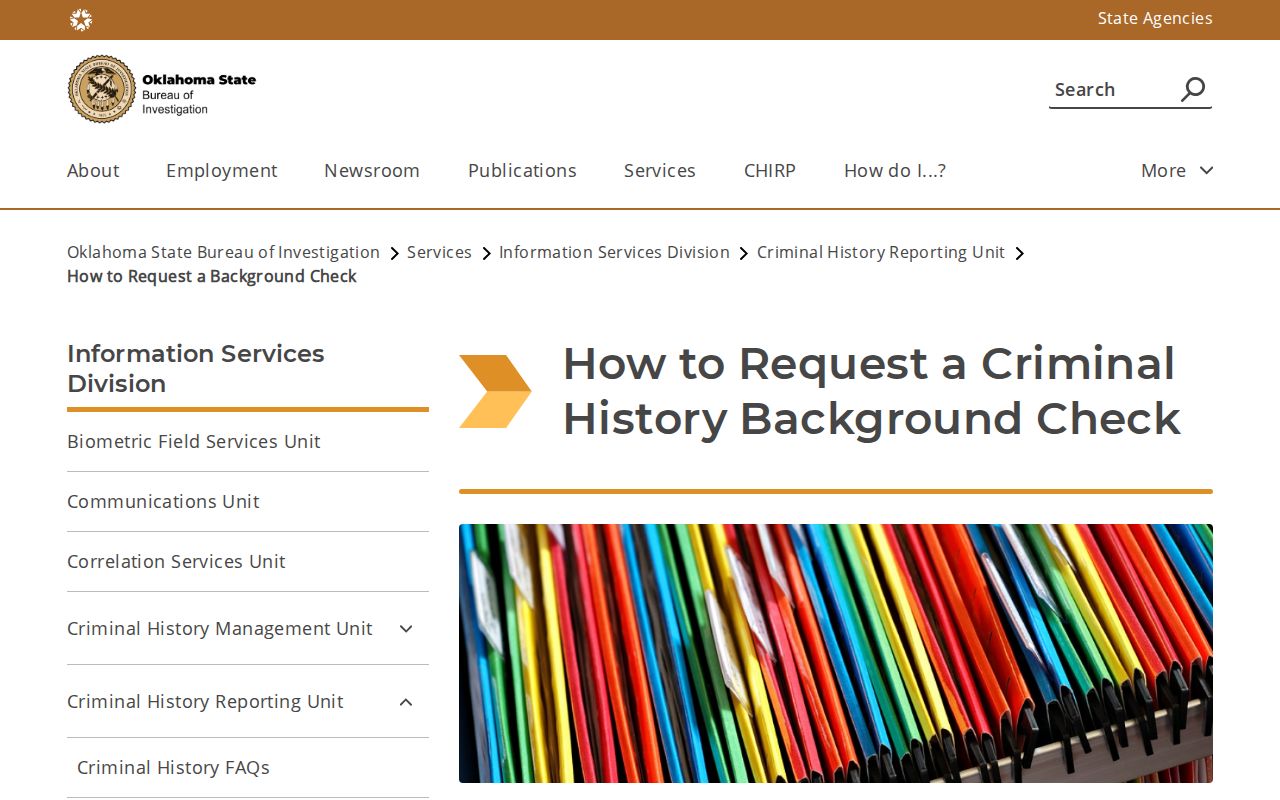
A request log should preserve the submission date, custodian reply, fees, redaction basis, delivered pages, and access date without publishing private requester details.
Note: A response that says no record was found should identify the system, date, filters, and any access gap before it is interpreted.